Saturday, August 4, 2018

We Most Certainly Do Need To Rethink Power Distribution In America!

On so many levels of course. Which is why, in addition to being a process oriented sort of guy, I am also a man of metaphor. Just can't help it I guess.

In any case, though, a part of our revolution here must be to rethink how we do power generation from not only the standpoint of a standardized fuel, but also from the standpoint that all considerations of "cost" must be thrown out the airlock. We won't even be able to save the planet, much less transmit power more effectively, if we do not first recognize that doing anything major, from this point on, cannot even be seriously begun to be discussed, unless you first accept that old considerations of a cost based economy must be thrown out as well.

The only way we're going to be able to tackle not only clean energy, but saving the planet, will be by coming up with a way to do an "effort" based economy. And the one that I have been attempting to describe in my postings here, and on my original Old Softy Concerns web site, is the only alternative in existence now that I am aware of. And unless a better one shows up pretty quickly I'm afraid this is as good as its going to get for us.

All of that being said, the next thing you would ask is: OK. So what standardized fuel are you talking about here? And naturally I think the standard should be hydrogen, produced in vast new quantities as a cryogenic liquid, via the primary reliance on sea based Yen Tornado Turbines; turbines that, with my embellishments to a sea based design approach, could produce at least a gigawatt each.

The next question then becomes logistics which I've already covered in my repeated emphasis on "Critical Social Logistics." Which is why I came up with the idea of Hybrid Dirigible Blimps that can be linked together to form airborne trains. And now that I've also refined that system to solve the loading/unloading problem, without needing airports (swarms of singular, self guided lifting fans would become the work tugs of this approach; lifting fans that would connect to standard connection sockets on all new airborne cargo containers). As such, all you would need is a few dozen square acres of land for lifting fan maintenance, and temporary container storage -- the lifting fans might direct deliver in many cases, as well as a road to freeway interface, so as to allow for direct placement on ground delivery vehicles where necessary. The trains themselves, then, would just orbit over unpopulated areas so as to lessen noise impact.

From that point on the question becomes, just how much more centralized electricity production do we need? You have to ask that question because you also want to be clear on why you think you still need large networks of high tension transmission wires, when you are already maintaining a vast network of roads and freeways. And since extreme weather will become a fact of life, for as long as we can keep that fact going, while we get the CO2 (and whatever else) out of the atmosphere, we will not want to be constantly rebuilding these expensive networks. Why not instead just deliver cryogenic hydrogen to fuel cells, via robotic vehicles (which we could also do a lot better with if we rethought a standard way to do it), to as granular a form of ultimate usage as makes practical sense. Maybe even to each home, and community production, or service, site.

This is not to say that you would necessarily want to do without transmission wires completely, but only that you might use them sparingly as intra community interlinking; with the communities also then having combinations of battery stations, larger community fuel cells, and local solar panels, to help fill in with for redundancy. That way, the communities, as nodes, might provide their own regional systems of interlinking, community to community; thereby providing regional sharing to some degree.

Just more to think about. And I can only hope you've made the commitment to that thinking on a regular basis now.

We’ve been talking about a national grid for years. It might be time to do it


See Also:
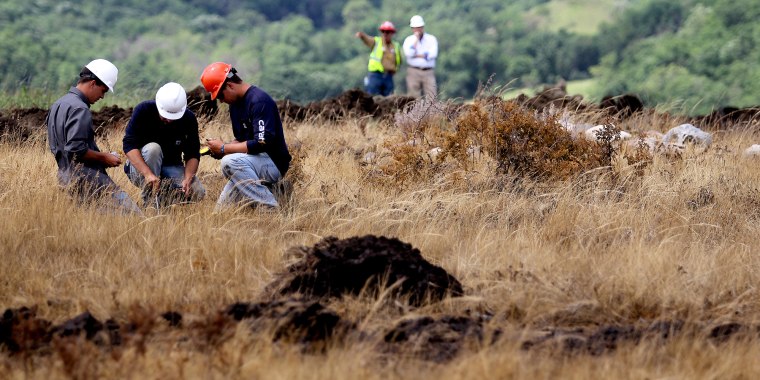
Image: Environmental workers take samples to assess level of contamination, and surveyors measure size of affected area at the site of saltwater spill
Tyler Bell / AP

SALTING THE EARTH

North Dakota farmers struggle with a toxic byproduct of the oil boom

As oil production breaks records, farmers worry the industry won't keep up with its poisonous byproduct: saltwater spills.


Wednesday, August 1, 2018

The Real Problem Is That Smart Capital Doesn't Sit Still At All Any More

You know it used to be that the mavens of money would chide us lowly working people for not saving enough. Savings, it was berated upon us, were the investment power of a growing economy, after all, and without savings, where would we be?

They would tell us that, of course, at the beginning of a new year. This, after telling us, only a few months previously, that it was the consumer who really needed to get out there and make this a good Holiday Season for consumer products that made American business thrive so well; and they continue to do this, pretty much the same way, on at least a semi regular basis.

The ironic thing now is to wonder why big business itself doesn't save more money. You know, for a really extreme weather kind of day, or bubble burst they think they're too big too care about. They have, after all, been awash in cash for quite a few years, and counting now. But the name of the game has mostly been stock buybacks, and buying into some new kind of vertical, or horizontal, or combinations of both, integration to get bigger because bigger is now the big thing.

So the question then becomes why are the banks in the lending business at all any more when no one wants to leave money sit there; especially if the economy got used to having virtually free money. And how long do you think it will be before there is war declared, by a certain demented clown car of an administration, on the Fed if it tries to make money interesting enough, all by itself, to induce anybody to let it sit as something other than a demand deposit.

Let us also recall that we must now think of money as electrons in electronic circuits. And that this implies, very fundamentally, a new kind of movement emphasis, and a whole new expectation of what a cycle of investment, process creation, and marketable deliverable, will require. And if you can do that sort of thing, more and more, by simply crunching numbers, to get more numbers, why would you want to bother with banks at all in the first place? Because, at that point, you will be expanding on your own expansion, limited only by where to put the servers, and where to get the power to run them.

An explanation of the yield curve — and why Trump's anger at the Fed isn't likely to change it


See Also:

EVERYTHING UNDER ONE BOOT


Year after year, thousands of firms across the economy swallow their competitors or other businesses in the supply chain to control more of their market.


EDUCATE YOURSELF


The tax cuts have put stock buybacks in the spotlight. Here's what they are and why you should care.


ANYTHING FOR AN EDGE


Access to cheap electricity can make or break a cryptocurrency mining operation, and firms angling to strike it rich in an industry where delays can and will cost digital money will do just about anything to get it, as soon as they can.


[Post Note: So naive. And yet so predictable that so many of you would think you know what it is to "Dance With The Devil," thinking then that you don't have to worry about being the "hindmost" at all any more. What a foolish notion. One of these days, you'll see. J.V.]
One Of These Days


[Post Note: Because money is now like electrons in electronic circuits, NetFlix, as well as Amazon, is in a quite precarious position. Investors may have been relying on the ever increasing rise in subscription numbers as the means to keep believing in this as an ongoing investment opportunity, but the limits of that may already be seen by both companies, and investors, hence the new trend lines for price increases that both companies are now exploring. And in that will be a crucial test. Can they raise them fast enough, without raising them too much too fast?

But in this also is there the other factor. The factor that Elon Musk has been learning ("Live By The Market, Die By The Market"). That whatever market your selling in, it is itself subject to its own market turbulence, and disruptions.

At the most basic level, though, is this: what happens when increasing global instability leads to decreasing ability to purchase much of anything, for the vast group of working people who fuel our consumer economy, other than food, lodging, health insurance, and the cost of getting to and from work, as well as the cost of staying in the rat race at all -- which usually comes in the form of some sort of self medication. And where do you think "Binge Watching" is going to end up as a priority, when it's all you can do to pay for what you consume while you are watching; as in the alcohol, or pot, or whatever other type of drug, you have to have to really make the binge watching complete; of which, of course, the newest Hi-Fi VR game might just begin to qualify; especially if they get any kind of cleverly, fully integrated, haptic physical feedback system in place, so as to make it a truly "full body" experience. But then, of course, the quality of your workers is going to start going down and then what do you do? And so on. J.V.]

How Is Netflix Actually Making Money?


You Have To Broaden Your Idea Of Point Of Sale

If you are going to truly understand just how complicated paying for something has become.

I can say this because I have had way too much experience creating not only the software that mediated some the direct aspects of "point of sale," in a, say grocery store (just try and do programming for companies like Nichirei Foods Usa, or Trident SeaFoods, or Tyson Chicken, and see the mind boggling minutia of promotions kickbacks, promotional incentives, and what all else, that has to click over, change of state wise, in a large array of databases, every time a package of imitation crab is purchased), but also in commercial exchange situations where the thing being purchased is all part of hospitalization services. And when you start talking about that you really get into crazy minutia.

You do that especially when it comes down to arguing over who should be on the hook to pay in the first place, which I can tell you, again from direct experience, is quite something to behold when hospitals and insurance companies lock horns over charge details on a claims submission; because certain diagnosis codes supposedly know better what to do with a patient than the doctor does.

Just in that dear reader is there launched vast armies of effort, back and forth, across this country, to make one, or the other guy, pay for what has been purchased. Effort, you have to understand, that far exceeds, in total relative cost, than that created by just paying the damn bill and being done with it would have resulted in. And that has to be so because if any one insurance (read that as "Capital Formation Company") company didn't do everything it could to limit what it has to pay, on a quarterly basis, it would surely be rendered insolvent in quick time, by the markets in question, and be absorbed by a more effective (read ruthless) player there.

And this is but one form of the insane wastage that is this galaxy sized, waste engine, we call an obsolete economic operating system.

A HARD SELL


Or, why paying for stuff is so complicated now.


See Also:
THE INTERNET IS FULL OF SHIT


When it costs as much to retail 200,000 things as one thing, the world gets a little odd.


WHAT COULD GO WRONG


Sources say banks are concerned about how Facebook would handle data privacy when it comes to financial information, which is often more sensitive than Facebook user details.


'I DIDN'T [DO THIS] TO BUY A LAMBORGHINI'


Dr. Gajendra Singh is suing to overturn North Carolina's "certificate of need" law.


Monday, July 30, 2018

Shared Masterbation Might Make The Very Difficult Politics Of Compromise A Lot Easier To Do

And I know you are either laughing, or at least smirking, at this suggestion. But it is, nevertheless, quite true.

I have posted on this before, though for the life of me I can't remember the precise one, or the key phrases from it. Hopefully someone enterprising, and not fully read up yet here, will locate it for me and share that with us (doesn't hurt to ask for help after all).

In any case, though, the point here is that, if we could come up with a way to do group, shared masterbation, and do it anonmyously so that only the genitals are exposed, and also do it with some emphasis on formality, and a higher purpose to be served, it could be a genuinely important tool to take the edge off negotiations; especially if a lot of testosterone is involved.

This would be even more so if we could link sexual climax with the transcendent power of letting go of the our identities for a brief period as the mystics trained themselves to do with higher levels of meditation, and what drugs like LSD can do in one fell swoop. It is in that transcendent act that I believe lies the possibility of not only receiving information across vast arrays of so called boundaries, back and forth over every scale of consideration, from the inside out, to the outside in; that not only is that possible, but also that this "conditioning" serves to improve the individual in ways I have barely scratched the surface on.

So. Smirk, or laugh all you want. I believe that I am living proof that transcendent meditation has real benefit. Just think what we could do as a species if we could lock down addiction itself in a positive sexual outlet, and get a transcendent, improving experience out of it as well. If you have any imagination at all, you will see this as the tremendous opportunity it is to further, and better, the human condition. And maybe even have a lot more good sex in the bargain.


I LOVE MULTIPLAYER GAMES


I went looking for other men who consider mutual masturbation an important sexual experience in its own right.


If We Go To Hydrogen Production On The Scale That I Envision

We won't have to worry about having only batteries to store power in. We will also be able to store power as a cryogenic liquid.

There is also hope in not only further technological development in battery tech, but also in using graphene supercapacitors as well. And certainly, having another incentive to utilize the carbon we begin pulling out of the atmosphere, in ever greater increments of throughput capacity, wouldn't hurt either.

I can say we would have these "greater increments of throughput capacity," as well as the grand scale of hydrogen production I envision, because we will have realized that a money economy is in no way prepared to deal with what it will take to accomplish these tasks. And in that realization we will come to recognize that only a comprehensively new way to operate will allow us to organize the major, national, mobilization of combined effort this will take. A mobilization on the same level of criticality as was demonstrated when we last fought a global conflict, and on more than one major front, back in the forties.

That is the only way we will be able to save ourselves, as well as the rest of humanity. And as impossible, or, outlandishly unlikely as it might sound, I still remain resolutely hopeful that we will do this as a Nation.

A FAULT WITH THE BATTERY


Fluctuating solar and wind power require lots of energy storage, and lithium-ion batteries seem like the obvious choice — but they are far too expensive to play a major role.


See Also:
[Post Note: Of course, if we didn't have centralized, land based (land is too precious now), power production in the first place, we might not need to worry so much about it being so vulnerable. Build huge numbers of sea based, Yen Tornado Turbines (in conjunction with floating habitats), however, and then have the presence of mind to have a truly flexible delivery methodology, as in Hybrid, Dirigible Blimp, Air Trains; you might find yourself with some significant new, viable options, for much more efficient, and clean, energy. J.V.]
A LOT OF LINES TO CROSS


Bringing down the grid is a lot harder than just flicking a switch, but the danger is real — and it may never go away.


UP IN THIN AIR


Using the same underlying chemistry that propels spacecraft, hydrogen cars could still become the car of the future.